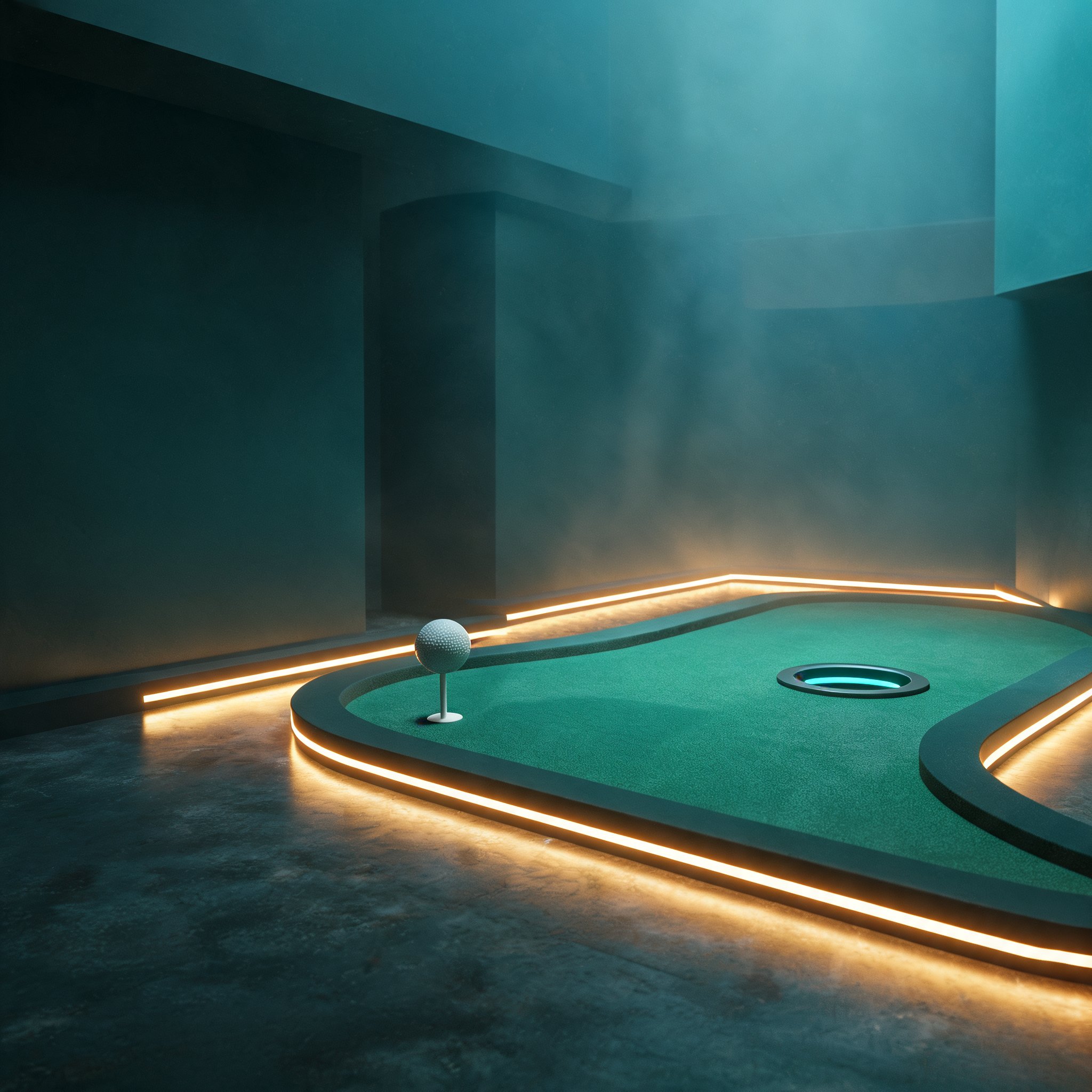
Holovis is recasting mini golf as a connected game platform. Its 360Golf brand keeps the familiar putter-and-ball format but replaces the paper scorecard with an automated scoring layer, then builds gamification and analytics on top of it. The company is presenting the system at IAAPA Expo in Orlando, 16–20 November, at the Holovis booth #S448, and at the Land Leisure & Tourism Show at Birmingham's NEC on 4–5 November at booth LLT360, with playable demonstrations available at its Orlando office.
The pitch is aimed at the competitive socialising market, where operators need attractions that fill space, serve mixed audiences and generate food and beverage spend. 360Golf deployments so far span the UK, Europe, the Middle East, North America and Asia Pacific, according to the company.
Familiarity as the differentiator
Stuart Edgington, global director of business development, argues that the format's advantage is that it does not need explaining. Mini golf, he says, is already among the world's most accessible leisure activities, and most markets have a baseline understanding of it. Rather than reinventing the game, 360Golf layers technology on top to make it more competitive, more interactive and more commercially measurable.
That positioning matters because operators are looking for intergenerational appeal. Edgington says the format can draw families, competitive-socialising young adults and corporate groups, which makes it useful as an anchor attraction rather than a single-demographic add-on. Guests register, collect an assigned smart ball and begin playing, so the experience needs little staff explanation or supervision at the start of a round.
Automated scoring and the game layer
The technical foundation is automated scoring: smart balls, tees and cups work with the HoloTrac scoring system, which removes pencil-and-paper scoring and acts as a referee when competition is close. On top of that sits a suite of gamified features — SuperShots that offer alternative ways to score, Triumphs that present awards and unlock challenges, plus bonuses, on-course games, player accounts, achievements, leaderboards and video celebrations.
Project manager Maaz Ussen describes the combination as sophisticated technology that feels effortless. Business development director Matt Dobbs frames the game layer as a retention mechanism: more reasons to compete, to celebrate and to compare scores at the end of a round, and therefore more reason to come back.
Analytics as an operating product
Underpinning all of this is DeepSmarts, an AI engine that gives operators data on player behaviour, seasonality and course performance. Edgington says the information can support higher uptime, show how players interact with the course, and suggest where operations might be adjusted, with Holovis offering it as an additional service. The same data has informed a design aimed at increasing dwell time and secondary spend, with capacity optimised at up to 80 players per hour per course.
Dobbs argues the operational gain is straightforward: because guests can use a kiosk, understand the game and start playing without staff help, the venue team is freed to manage guests and serve food and drink. Remote diagnostics are part of the offer too — Ussen says engineers can view course data and replay incidents to identify a fault.
Delivery formats and timelines
360Golf is sold in several configurations, and the choice largely determines how quickly a venue can open:
- Tech-only retrofit: scoring and gamification added to an existing mini golf course, with installation schedules of roughly six to eight weeks.
- Catalogue holes: tried-and-tested hole designs from 360Golf's standard packages, installed and ready to play in eight to 12 weeks.
- Custom builds: fully bespoke courses that can take upwards of six months, including IP-led designs.
The flexibility extends to physical constraints. For Norwegian Cruise Line's Tee Time installations — four so far — the course uses marine-grade, IP-rated hardware, including rugged cups and tees and specialist screens, to deliver the same experience at sea.
What the installed base shows
At Butlin's Bognor Regis resort, the £15m PLAYXPERIENCE indoor activity centre, which opened in 2024, houses three nine-hole 360Golf courses: one with neon glow effects, a Las Vegas-themed layout and a wheelchair-accessible music-themed course. Dobbs says the attraction has exceeded the client's expectations, with around 5,000 players in a busy week and gross revenue of roughly £40,000 per week. The project also pushed the team's work on inclusive design — left- and right-handed play, putter sizing, drop-down top caps so wheelchairs can reach the course, and spacing between holes to limit crowding.
Other installations show different uses of the same platform. Netflix House's Top 9 course is fully custom and IP-led, with themed holes drawing on One Piece, Squid Game and Floor is Lava. Super Social in Leopardstown, Ireland, uses 12 holes from the sports-themed package. For multi-site operators such as Saudi Entertainment Ventures (SEVEN), the argument is consistency of core technology across locations, with variation in theming, layout or branding layered on top. A project for Lucky Duck in Norway adds two play routes on each hole.
Limits and where the product goes next
The company's read on its own market includes a ceiling. Edgington expects competitive socialising eventually to reach peak saturation, which is one reason Holovis is examining adjacent uses of the technology. It is working with Roxy Leisure to add stroke-counting to crazy pool tables, and Ussen says the ambition is to apply the scoring system to other sports.
On gamification, the stated next steps concern engagement beyond the round itself — for example, using collected data to predict which player will score highest, in the manner of a fantasy league, while guests are waiting to play. Those are described as ideas in development rather than shipped features.
For operators, Dobbs says the starting conversation is about the venue's constraints, audience and commercial model: whether the right fit is a catalogue course or a custom build, whether the target is weekend young adults, families, or both, and how the operator expects to recover the investment. The company describes the offer as turnkey rather than a course sale — a claim that, like the trading figures above, comes from 360Golf and its clients' reported performance rather than independent verification.