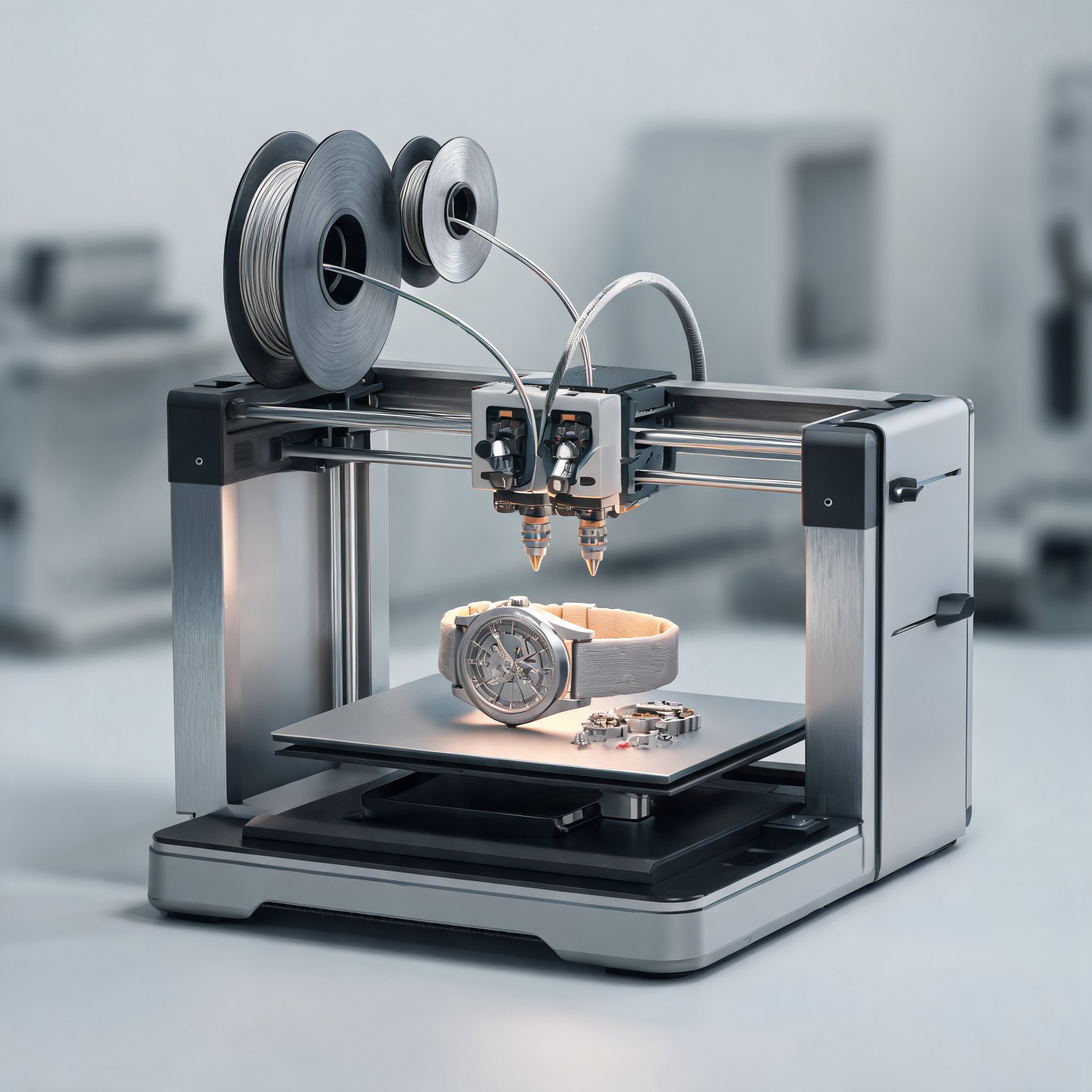
Bambu is gradually disclosing features of its upcoming H3C 3D printer, and the latest teaser shifts from multi-color output to multi-nozzle and multi-filament compatibility. A multi-component watch image illustrates the concept: a 0.4 mm nozzle with 1.75 mm filament for the rigid case, a 0.2 mm nozzle with 1.75 mm filament for fine details, and a 0.4 mm nozzle with 2.85 mm filament for a soft strap that appears to be TPU.
The example points to two possible capabilities. First, Bambu appears to be preparing 2.85 mm filament support for soft, rubbery materials such as TPU. Second, and more significant for existing users, the company is suggesting that 0.2 mm and 0.4 mm nozzles could be used within the same print.
Existing limits and open questions
Bambu’s current dual-nozzle machines, including the H2D and H2C, are described as unable to mix 0.4 mm and 0.2 mm nozzles in one job; users can select only one nozzle. The teaser implies that multiple nozzle and filament sizes could be combined in a single print, presumably across a multi-object job. Software restrictions are the stated obstacle on existing hardware.
It is not yet clear whether the capability would extend to all compatible Bambu printers or be limited to the new flagship H3C and the smaller P3C. The P3C has not been formally announced. Bambu has also released a teaser video showing watch components printed in place as a single part with multiple nozzle and filament sizes. That supports the direction of the feature, but the final availability, software support and material compatibility still need confirmation.