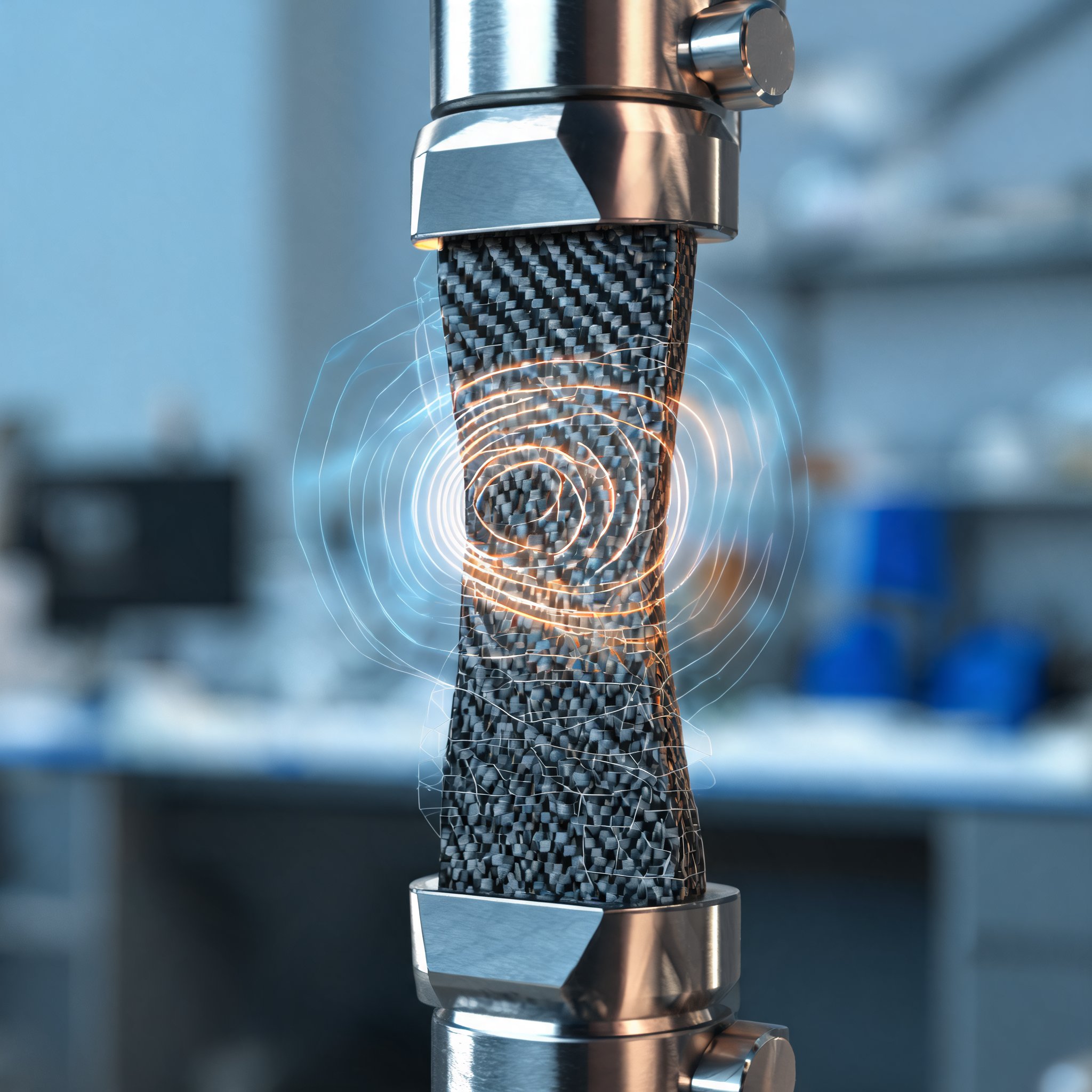
High strain rate testing can give engineers material data that better reflects rapid impact and crash conditions, according to Andrea Incardona, an application engineer and product specialist at Instron. In the article, Incardona argues that simulation accuracy depends not only on the model but also on how well the material data represents the loading conditions a component will face.
Many materials have strain-rate-dependent properties: their mechanical response changes as loading speed rises. A material characterised under quasi-static conditions may therefore behave differently in a rapid impact or crash event. Incardona presents this as a practical gap for design teams that rely on conventional material data when evaluating crash performance.
Study points to simulation gap
To illustrate the issue, the article cites a 2025 study in the SAE International Journal of Materials and Manufacturing, “Influence of Strain Rate Effect on Mechanical and Crashworthiness Properties of CFRP Composite Structures.” According to the article, incorporating strain-rate-dependent material properties into crash simulations reduced discrepancies between simulated and experimental results. Peak acceleration discrepancy fell by 6.5%, while mean acceleration and displacement discrepancies fell by 5.9% and 6.3%, respectively.
The figures are presented as evidence that the relevance of material data matters as much as its quantity. If strength, stiffness, deformation mechanisms or failure behaviour change with strain rate, a model built solely on conventional data may not accurately represent a rapid event. High strain rate characterisation is intended to fill that gap by measuring material response across a wider range of loading speeds.
Testing range and data capture
Depending on the material, specimen geometry and test method, Incardona says materials can be characterised from quasi-static conditions up to strain rates approaching 1,000/s. Such tests can last only 3 to 10 milliseconds, requiring data acquisition systems able to resolve rapid changes in force and deformation.
Instron says its high strain rate testing systems support data acquisition at up to 200 kHz. The article also points to digital image correlation (DIC) as a way to gather additional information about strain development across a specimen, with analysis tools supporting data processing and theoretical modelling. These are the company’s stated capabilities; the article does not provide independent performance results for the systems.
Implications for material choice and development
Beyond simulation, the article argues that dynamic characterisation can inform material selection. Two materials that look comparable in conventional strength and stiffness tests may respond differently under rapid loading, deforming, absorbing energy or failing in different ways. That distinction can matter when performance must be balanced against weight, as in automotive crash structures or aerospace components.
Incardona also places testing earlier in product development. Dynamic data can be measured, fed into simulation, used to compare design options and then checked through physical validation. In that sequence, material testing is not only a final check on an existing design but an input for assessing suitability and refining components.
The broader claim is that material data is only as useful as its relevance to the conditions a component will face. By revealing how materials respond to rapid loading, high strain rate testing can give engineers a more complete basis for simulation, material selection and design decisions. The extent of the benefit will depend on the material, the test method and how the resulting data are incorporated into the model.