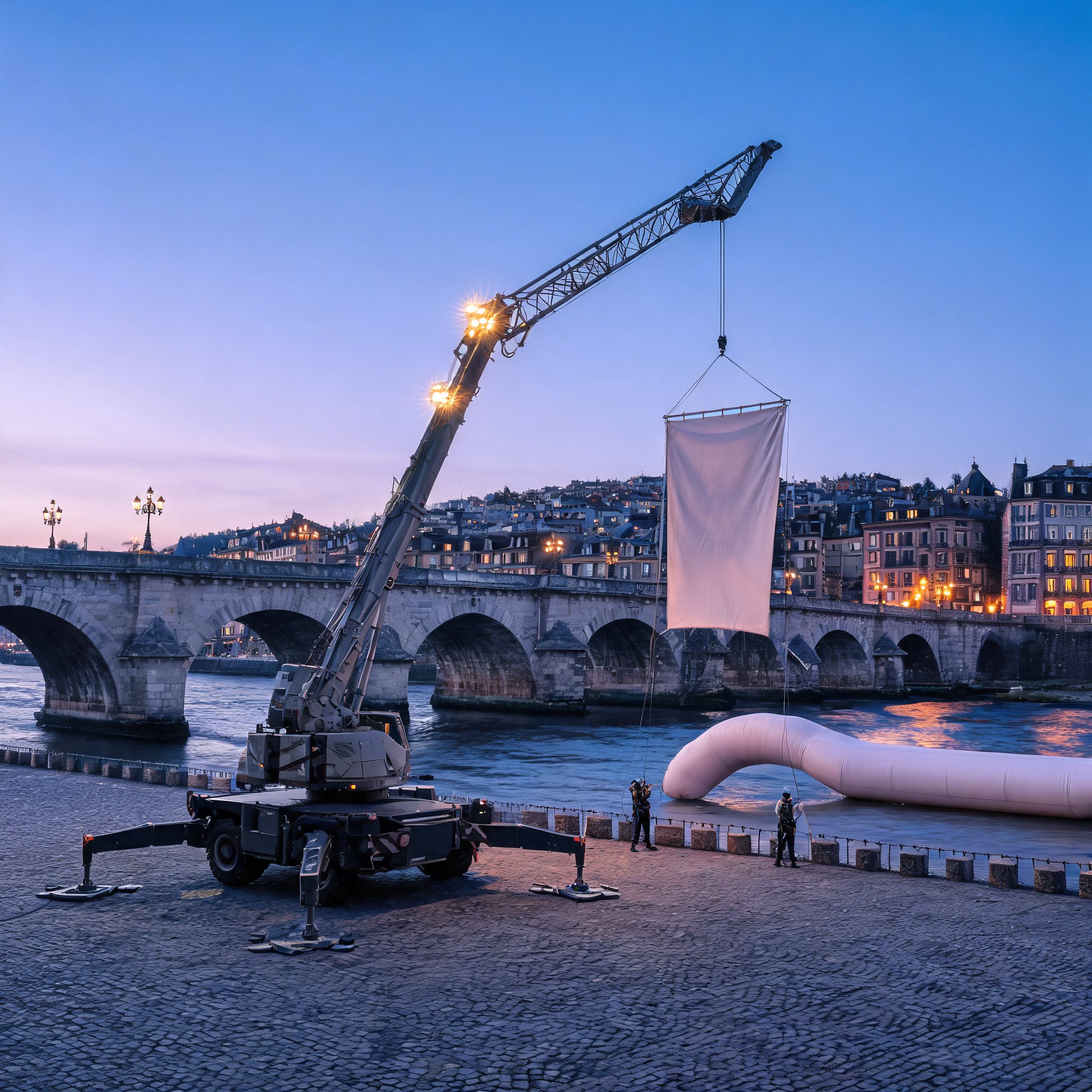
A Liebherr MK 88-4.1 mobile construction crane operated by the Ponticelli group of companies has repaired a historic Paris bridge and reinstalled a damaged piece of public artwork. The work took place on the Pont-Neuf, where the crane restored parts of 'La Caverne du Pont-Neuf,' an installation by the French artist JR.
The temporary artwork was created as a tribute to the wrapping of the Pont-Neuf by artists Christo and Jeanne-Claude, first installed in 1985. The inflatable structure is approximately 120 metres long. In early June, violent gusts of wind and hail damaged parts of its outer shell.
According to Ponticelli, a French lifting and industrial services company, it was on site within a few hours of the damage to develop a lifting solution with the client. "As well as repairing the tarpaulin, we had to carry out a lifting operation safely in almost constant wind and under considerable time pressure," said Louis-Arthur de Quatrebarbes, head of the handling and lifting agency at Ponticelli.
Working within a landmark
As the oldest bridge in Paris, the Pont-Neuf offers limited space for work and receives a large number of daily visitors. Load-distribution plates reduced ground pressure, while safety and traffic management measures ensured the operation could be carried out safely.
The team had originally planned to use a larger Liebherr mobile crane. Because of the tight conditions, the Liebherr MK 88-4.1 was moved in instead. Its 45-metre-long trolley jib reached all the damaged areas of the structure, and the four-axle design allowed it to be relocated easily from one side of the bridge to the other, where storm damage had also occurred. The short set-up time and compact outrigger system further facilitated the work.
The crane cab could be moved at working height, giving the operator a clear view of the approximately 18-metre-high structure and the rope access technicians. Boom-mounted spotlights ensured optimal illumination of the work area during night-time operations.
Night shifts and continuous monitoring
The repair work was carried out over four night shifts. Damaged fabric sections weighing between 200 and 400 kilograms were lifted and reattached in collaboration with rope access technicians. Because the site sits in a wind corridor along the River Seine, weather conditions were continuously monitored, and the crane operator and the rope access technicians communicated continuously by radio.
Before work began, the team carried out site inspections, load calculations and collision analyses of the surrounding buildings. A 360-degree test then confirmed the planned crane positioning.
Ponticelli described the project as more than a conventional lifting operation. "We are proud to have been part of this work of art," de Quatrebarbes said, quoting JR's remark that the installation of the artwork is part of the artwork, and adding that the crane is part of it too. He said the visually striking deployment of the MK crane created a magical moment.
With its deployment on the Pont-Neuf, the Liebherr MK 88-4.1 demonstrated the combination of reach, compactness and flexibility it offers for demanding inner-city projects, where heritage conservation, confined spaces and a high level of precision come together.