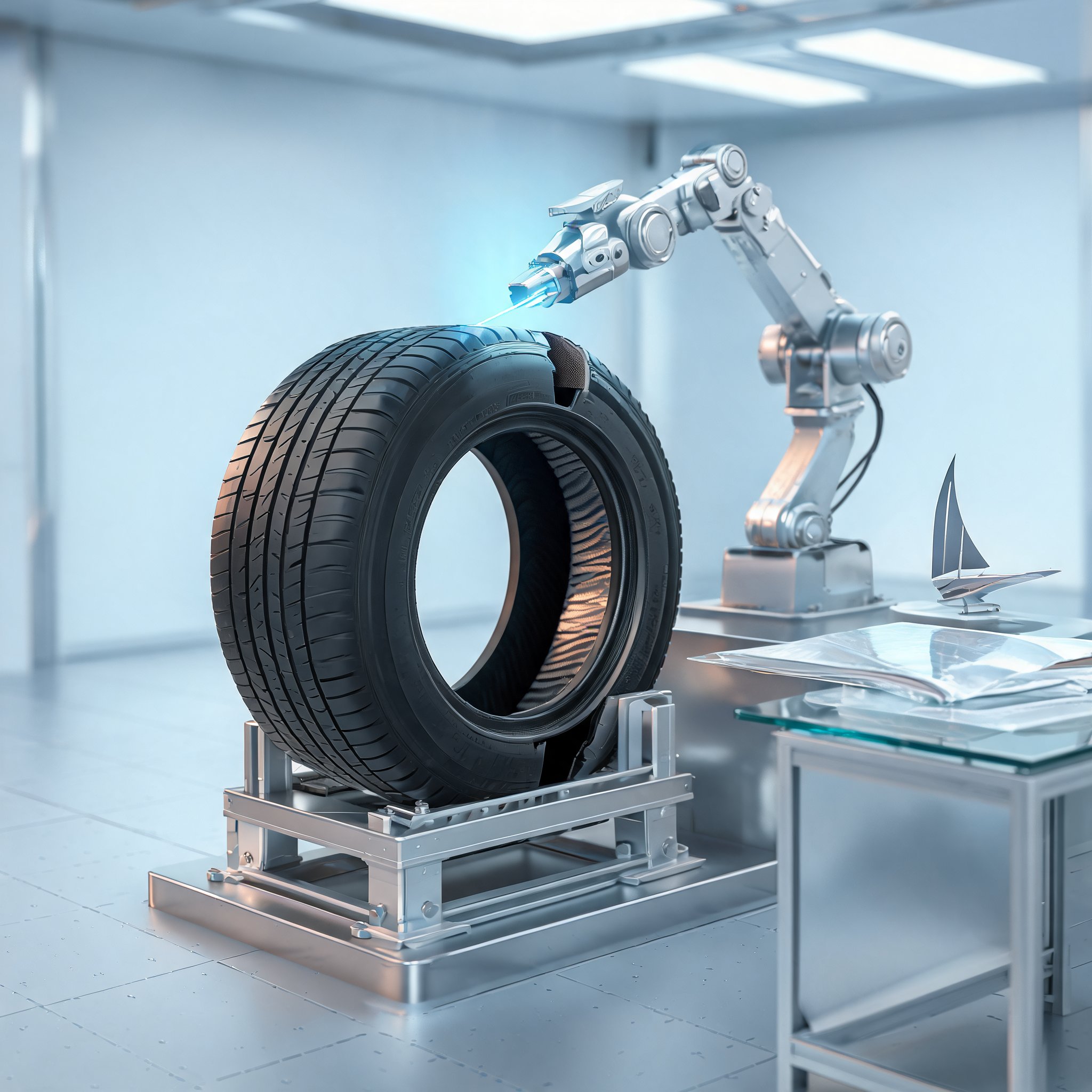
Michelin and four academic partners have inaugurated a joint research laboratory in Clermont-Ferrand, France, targeting advances in tire technology, manufacturing processes and new applications for flexible composites.
The I-TireLab partnership brings together Michelin, the University of Poitiers, Grenoble Alpes University, Grenoble INP – UGA and the French National Centre for Scientific Research (CNRS). Announced Nov. 4, the project represents a total investment of approximately €4.5 million over four years. Its stated aim is to strengthen ties between academic research and industrial application by combining data analysis, mathematical modeling and experimentation.
Four research areas
The laboratory will organize its work around four topics:
- Tire condition monitoring: developing real-time estimates of tire wear and grip from data produced by sensors already fitted to vehicles, so that condition can be assessed without additional specialized equipment.
- Vehicle control: studying how tire condition and grip information can be fed into vehicle control systems to optimize braking performance and improve stability and efficiency.
- Rubber manufacturing: building simulation and control tools that help manufacturers plan equipment operations and optimize production settings while holding rubber quality consistent and cutting raw material waste and energy consumption.
- Flexible materials: examining how flexible materials influence air and water flows around objects, and developing control methods that change the shape of components to modify the surrounding flow.
Researchers will be given access to industrial facilities, demonstrators and testing environments so that their methods can be evaluated under near-real-world conditions. Michelin said findings could eventually feed into future innovation projects.
Linked to digital twin and wingsail work
One planned application is Michelin Touch Intelligence, a tire digital twin the company introduced in May 2026. The technology combines vehicle sensor data with Michelin models to estimate tire pressure, wear, load and grip in real time without extra sensors, and is designed to work across vehicle brands and models.
The laboratory's work on flexible composites could also support Wisamo, Michelin's inflatable and retractable automated wingsail for ships, which uses wind to supplement vessel propulsion and reduce fuel consumption. According to the company, the first sail is in the delivery phase.
Roles and training
Philippe Jacquin, Michelin's general manager and director of research and development, said the partnership would help translate scientific research into practical innovations involving tires, manufacturing and tire-vehicle interactions.
Michelin will contribute expertise in tire simulation, materials, industrial processes and product-use data, while the academic partners will supply theoretical and methodological know-how to develop and validate new approaches. The collaboration will also support training for young researchers working across fundamental research, experimentation and industrial applications.
Guillaume Mercère, director of I-TireLab, and co-directors John Martinez-Molina and Thibault Dairay said the initiative would bring researchers, engineers and young scientists together to improve mobility safety, manufacturing processes and flexible-material applications. The partnership builds on existing collaboration between Michelin and the academic teams and establishes a longer-term framework for converting data into knowledge and practical solutions.